Samyang Foods (003230 KS)
The "hottest" Korean instant noodles maker at 14x run-rate P/E

Disclaimer: Asian Century Stocks uses information sources believed to be reliable, but their accuracy cannot be guaranteed. The information contained in this publication is not intended to constitute individual investment advice and is not designed to meet your personal financial situation. The opinions expressed in such publications are those of the publisher and are subject to change without notice. You are advised to discuss your investment options with your financial advisers, including whether any investment suits your specific needs. From time to time, I may have positions in the securities covered in the articles on this website. Full disclosure: I do not hold a position in Samyang Foods at the time of publishing this article. To reiterate, this post and the below presentation are for informational and educational purposes only - not a recommendation to buy or sell shares.
In South Korea, young people don’t ask prospective partners whether they want to “Netflix and chill.” Instead, they ask if they want to come over for some ramen.
This shows just how important ramen is in Korean culture. Now, ramen is being exported to other countries through companies such as Samyang Foods (003230 KS—US$2.9 billion), a producer of extra-spicy instant ramen.
Nobody expected Samyang Foods to become the success it is today. During the Asian Financial Crisis, the company went bankrupt and had to be restructured.
In the midst of the crisis, the founder’s daughter-in-law, Kim Jung-soo, was thrown into the mix. She had been a social worker, so she was an unlikely pick as a future CEO. But she proved adept at slashing costs, including selling the headquarters to help the company survive.
She managed to turn the ship around. And through creative product development and marketing, Kim helped put the company on a sustainable growth path.
For example, in 2006, when heading up sales and marketing, she helped introduce instant ramen with clear soup when all instant noodles had red broth.
Her next masterstroke was in the spring of 2010. She and her teenage daughter were on a stroll in downtown Seoul when they saw a long queue outside a fried rice restaurant. This particular restaurant was famous for its spicy food. Kim and her daughter observed that while customers were sweating and seemingly in pain from eating all those spices, they seemed to enjoy themselves.
Back at the lab, she became determined to develop an extra spicy version of Samyang’s ramen. After months of trial and error, going through 1,200 chickens and two tons of sauce, they created the first “Buldak” (= fire chicken) instant ramen.
Years later, this product went viral on YouTube, TikTok and other social media platforms. BTS fans became intrigued when singer Jimin professed his love for Samyang’s noodles. Members of Blankpink turned out to be fans of the product, too. Even Cardi B became a Buldak enthusiast, speaking highly of the product in a viral TikTok video.
Thanks to all this publicity, Samyang’s Buldak ramen has become an export success. From 2016 onwards, Samyang’s export sales have gone from almost nothing to now representing 75% of total revenues.
Alternative data sources suggest that growth is continuing at a rapid pace. In August, the number of Google search queries doubled year-on-year. The number of page views on Samyang Foods-related Wikipedia pages hit an all-time high. And prices for Samyang’s Buldak ramen at third-party sellers on Amazon have been high for years as the shortages persisted.
So, what makes the product unique?
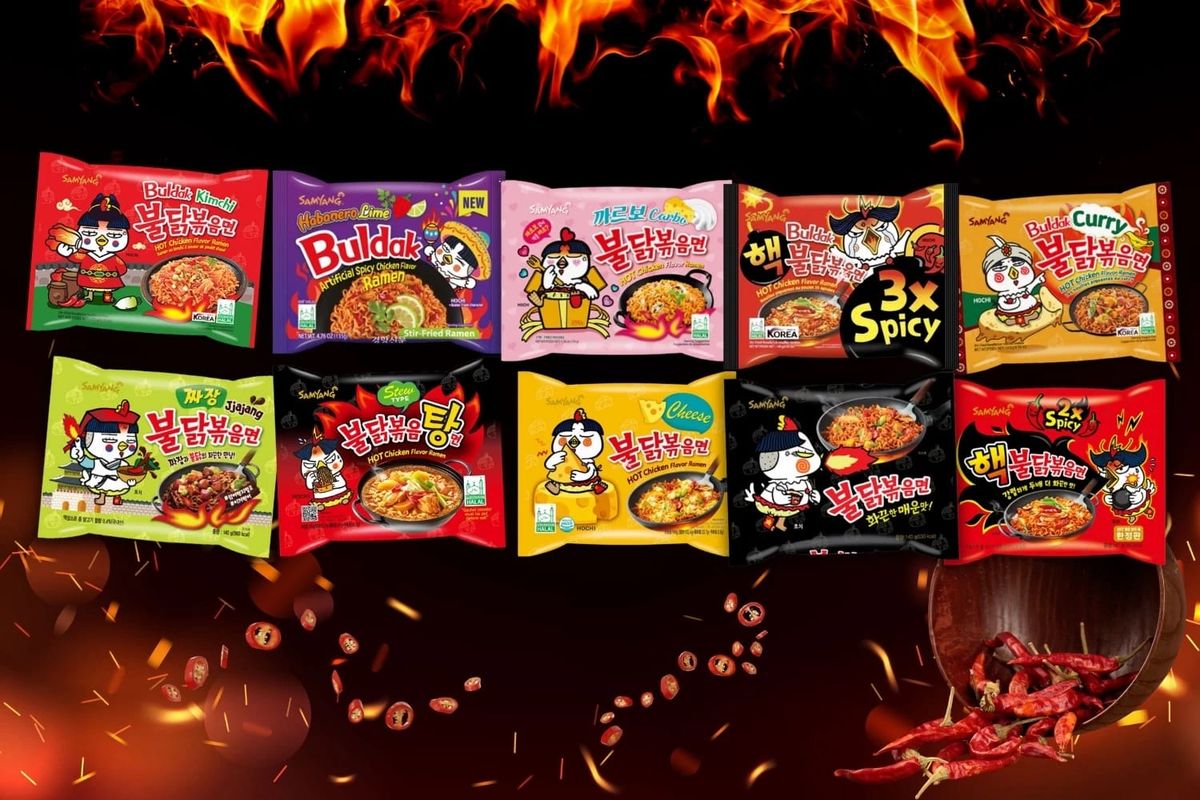
In my view, it’s an example of successful branding. Samyang almost created the category of extra spicy ramen and now dominates it. It’s built up a portfolio of instant noodles varieties, each with its own fan base.
I also think that the product is (mildly) addictive. I found evidence that capsaicin - the hot ingredient in chilli -triggers the release of endorphins and related dopamine. The spice creates a feeling of pain followed by a rush of endorphins.
Given the fast pace of growth, it looks like Samyang Foods will grow its top-line revenues by +40% in 2024. The current-year P/E will then end up at around 14x, if not lower. And once the second factory in the city of Miryang close to Busan is completed in 2025, capacity is likely to go up another ~30%.
The big question is whether Buldak noodles are simply a fad. Are they here to stay? I tried the noodles myself, and I consider Samyang’s Buldak noodles to be a genuinely good product. I see plenty of evidence of repeat purchases. And it’s encouraging to see that Samyang’s revenues in each market seem to go up over time, with no sign of any boom-bust pattern.
While it is possible that the current social media craze for Buldak ramen will one day end, you also have to give credit to Kim Jung-soo for popularizing the product. They’re clearly doing something right. That’s why I think we should pay attention to Samyang Foods.
A greater risk to Samyang Foods is if Kim Jung-soo retires. There’s been talk of her stepping down. That would be a problem because the son likely to become a successor seems inexperienced. Further, Kim’s husband was found guilty of stealing US$3.7 million of Samyang corporate funds in 2020. He went to prison, but they are still married. In other words, Samyang’s corporate governance is typical for a Korean food conglomerate.
Still, I think that Samyang Foods is one of Asia’s most exciting growth stories. Sell-side analysts are still skeptical of the story. But the numbers paint a clear picture: the noodles are simply flying off the shelves. And while the stock price has been on a tear, a run-rate P/E of 14x is not particularly high.