Seria (2782 JP)
Japanese discount retailer going through short-term turbulence

Disclaimer: Asian Century Stocks uses information sources believed to be reliable, but their accuracy cannot be guaranteed. The information contained in this publication is not intended to constitute individual investment advice and is not designed to meet your personal financial situation. The opinions expressed in such publications are those of the publisher and are subject to change without notice. You are advised to discuss your investment options with your financial advisers, including whether any investment suits your specific needs. From time to time, I may have positions in the securities covered in the articles on this website. Full disclosure: I do not hold a position in Seria at the time of publishing this article. To reiterate, this post and the below presentation are for informational and educational purposes and not a recommendation to buy or sell shares.
Seria (2782 JP - US$1.5 billion) is a family-owned Japanese discount retailer focusing on so-called 100-yen stores.
These stores are the Japanese equivalents of American “Dollar stores”, which sell a variety of items at uniformly low prices of just 100 yen (US$0.76 cents). Such items include simple clothing, kitchenware, beauty products, stationery, food, and so on.
100-yen stores have taken market share from department stores and general merchandise stores over the past thirty years. Customers are attracted by the low prices and their “treasure hunt” experience. And a reassurance knowing that whatever items they might pick up, the total bill won’t break the bank.
The market leader in Japan’s 100-yen industry is privately held Daiso, which has roughly 3,800 stores in Japan. Seria has about half as many stores, at about 1,900. While Daiso is popular among those looking for practical household items, Seria has a greater focus on design products, targeting the 30-50 female demographic.
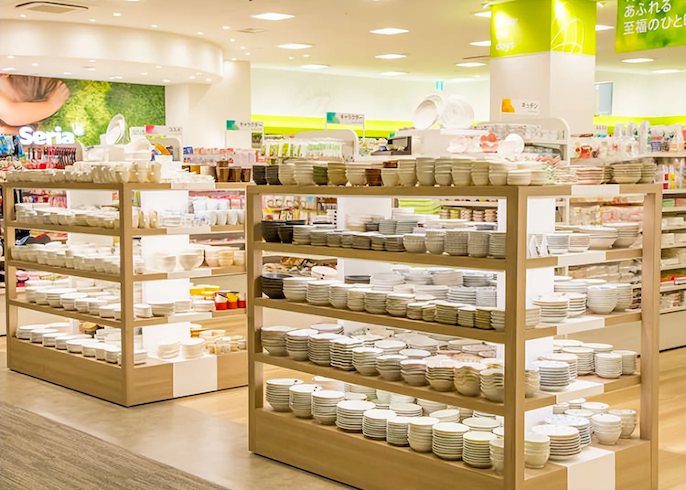
One YouTuber called Seria, “The classiest 100 yen shop in Japan". I think that’s an accurate representation. Customers tend to praise Seria’s clean and bright store environments as well as its cute and well-designed products.
Seria has achieved great success, with revenues compounding at 10% per year over the past two decades. Thanks to margin expansion, EPS has grown at an even faster rate of about 15%. Meanwhile, Seria has earned about a 20% return on equity, which is exceptional compared to most other Japanese retailers.
Much of Seria’s current success can be attributed to the current Chairman and President, Eiji Kawai. After he joined Seria in 2003, he introduced a POS system that gathered data on orders and inventories. And later on, he also developed an inventory management system that uses advanced algorithms to figure out what products to stock at any given point in time.
Eiji Kawai also launched a new store format called “Color the Days” with bright, pleasant shop environments and more organised aisles. These stores have sales per square foot in line with those of market leader Daiso. The roll-out of these stores explains Seria’s increase in its operating margin to about 10% in the fiscal year 2021.
Over the past year, Seria has been facing a serious challenge in the depreciation of the Japanese yen. Both Daiso and Seria remain committed to defending their 100-yen price point. But with higher input costs and rising inflation, that’s proving increasingly difficult. Seria’s gross profit margin has already fallen about 2 percentage points from 43.5% to 41.6%.
But I don’t think the weakening yen destroys the business model. This near-term challenge of rising input costs can be solved in several ways: Seria can shift its product mix to cheaper items. It can start to procure more items domestically. Or it can simply raise its prices, as American dollar stores have started to do.
In fact, Seria’s items already cost more than 100 yen since the 10% consumption tax is added on top of this amount. I personally think that customers are unlikely to care if the products cost a little bit extra. But for now, Seria’s margin pressure will remain as long as the yen remains weak and it doesn’t shift its pricing strategy.
Kawai is guiding for about 100-150 new stores every year, which is equivalent to about 5-8% growth in the store count. While the ASP hikes are unlikely at this point, Seria’s same-store sales growth has historically been around 2% per year. So you can probably expect high single-digit organic growth on top of a 2-3% dividend yield.
If you believe that Seria’s gross profit margins will come back to the 43% level once the pricing strategy has been adjusted, you’ll be looking at a 2026e P/E ratio of 10.7x, which compares to a historical level of about 18x.
The key risks are the near-term cost pressures that we’re seeing from the weak Japanese yen. Import tariffs on Chinese goods are another possibility.
Some investors question whether Seria can maintain its 10% margins when Can Do and Watts are barely able to achieve 3%. But a higher sales per square foot explains most of the differential. Seria’s cash flow conversion rate is excellent, it pays plenty of tax, and its balance sheet is clean. So I don’t see any signs of earnings manipulation.
From a corporate governance point of view, perhaps the only question mark is Eiji Kawai’s total control of the business. There is no counterweight to him. But at the same time, family-run businesses tend to perform better over the long run. Just be aware that a bet on Seria is a bet on Eiji Kawai himself.