LG Household & Healthcare pref (051905 KS)
Turnaround king "Suk Cha" well placed to deal with short-term COVID problems

Disclaimer: Asian Century Stocks uses information sources believed to be reliable, but their accuracy cannot be guaranteed. The information contained in this publication is not intended to constitute individual investment advice and is not designed to meet your personal financial situation. The opinions expressed in such publications are those of the publisher and are subject to change without notice. You are advised to discuss your investment options with your financial advisers, including whether any investment is suitable for your specific needs. From time to time, I may have positions in the securities covered in the articles on this website. Full disclosure: I do not hold a position in LG Household & Healthcare prefs at the time of publishing this article. This is disclosure and not a recommendation to buy or sell.
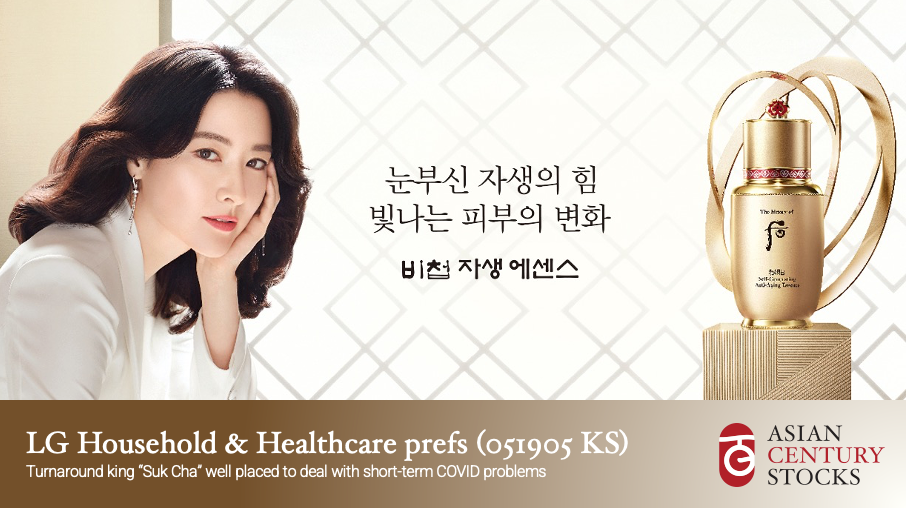
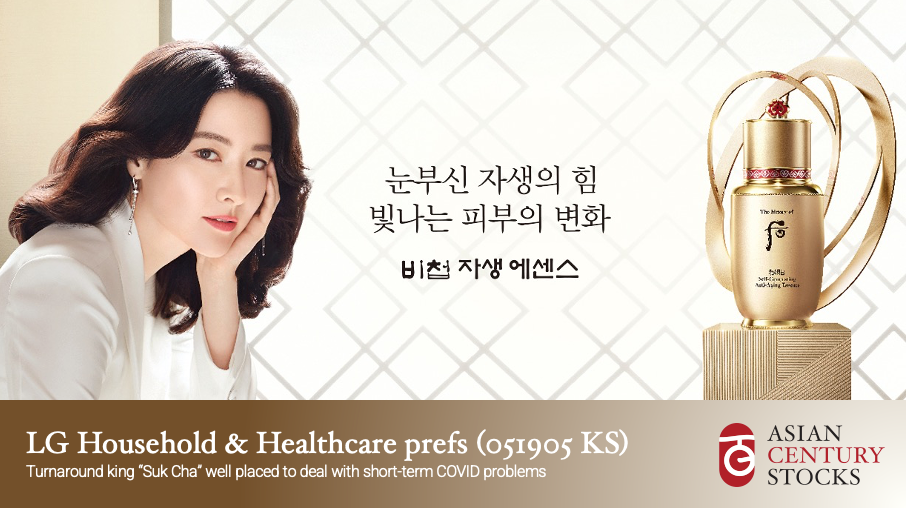
LG Household & Healthcare (common: 051900 KS, preference share: 051905 KS) is South Korea’s second-largest cosmetics company.
It owns brands such as “The Face Shop”, “The mystery of Whoo”, and “su:m37°”. It’s also one of Korea’s largest fast-moving consumer goods companies with 30%+ market shares in toothpaste, shampoos, detergents, fabric softeners, etc. And finally, the company also runs the Coca-Cola bottling operation for South Korea.
What’s unique about LG Household & Healthcare (“LG H&H”) is that it’s run by capable former Procter & Gamble executive Suk Cha. He’s a genius at brand-building. And he’s done several intelligent acquisitions for the company.
For example, in 2007, Suk Cha acquired 90% of Coca-Cola’s bottling operations in Korea for KRW 287 billion. In 2010, he acquired Haitai beverage for a token amount. Today, the beverage segment makes almost KRW 200 billion in profits each year, mostly from these two acquired companies.
Since Suk Cha took in 2005, LG H&H’s revenues have grown eight-fold and earnings per share ten-fold. Despite being an acquisitive company, return on equity has consistently been above 20%. Such a high return on equity is unusual in a Korean context.
While the Korean cosmetics market is mature, the Chinese cosmetics market has tremendous potential. According to Euromonitor, the per consumption of cosmetics is only €35 in China compared with €208 in South Korea. It’s plausible that China’s cosmetics market could eventually grow somewhere around 5x to 7x in real terms.