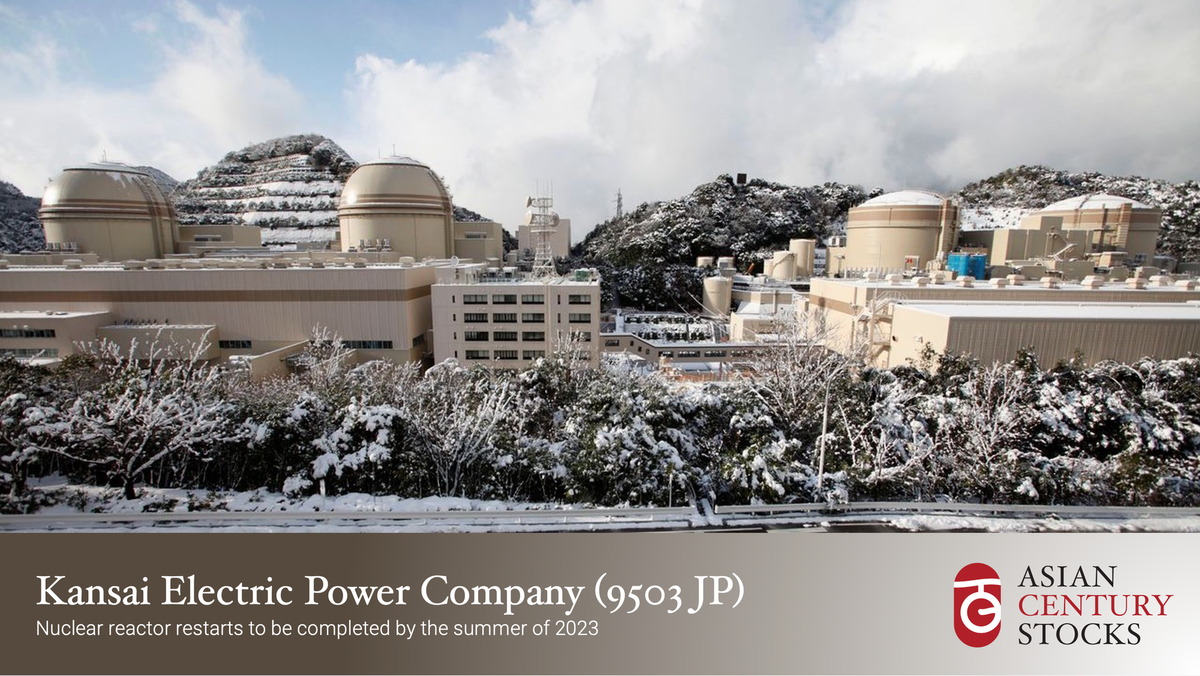
Kansai Electric Power (9503 JP)
Nuclear reactor restarts to be completed by the summer of 2023

Disclaimer: Asian Century Stocks uses information sources believed to be reliable, but their accuracy cannot be guaranteed. The information contained in this publication is not intended to constitute individual investment advice and is not designed to meet your personal financial situation. The opinions expressed in such publications are those of the publisher and are subject to change without notice. You are advised to discuss your investment options with your financial advisers, including whether any investment is suitable for your specific needs. From time to time, I may have positions in the securities covered in the articles on this website. Full disclosure: I do not hold a position in Kansai Electric Power at the time of publishing this article. Note that this is disclosure and not a recommendation to buy or sell.
Kansai Electric Power Company (9503 JP) is one of Japan’s largest electric utilities. It owns coal- and gas-fired, nuclear and hydroelectric power plants across the Kansai region surrounding the key cities of Osaka, Kobe and Kyoto.
The sector has been troubled by the forced closure of its nuclear power plants after the Fukushima nuclear disaster in 2011. The Fukushima nuclear power plant was not owned by Kansai Electric, but the company still suffered negative consequences as the government required all nuclear power plants to shut down temporarily.
Ten years after Fukushima, the country’s nuclear reactors are beginning to come back into service. The country has 33 operable nuclear reactors, and 10 are now in operation.
After the war in Ukraine, prices for imported LNG and electricity prices have shot up. Japan’s prime minister Fumio Kishida considers it a national priority to restart at least 9 nuclear power reactors before winter returns.
The Japanese public has also become positive about nuclear power, with the majority now favouring a return to nuclear power generation. The country’s CO2 emission targets for 2030 also require the country’s nuclear power plants to be restarted.
In Kansai Electric’s case, it owned 11 nuclear reactors before Fukushima and 4 have now been decommissioned. The remaining 7 are now in the process of being restarted. The plan is for all 7 to be operational by July 2023.
In such a scenario, Kansai Electric believes that it will be able to earn a JPY 250 billion pre-tax profit by FY2026, which at a ~30% effective tax rate would lead to a P/E of 6.5x and a dividend yield of 3.8%. Historically, the stock has traded at a median P/E of 14.1x.
The near term will be challenging. High prices for imported LNG and wholesale electricity are pressuring the margins of electric utilities. While electricity rates include a fuel price component, they operate with a lag, and there is also a cap on how much tariffs can be adjusted year by year.
There’s also a risk of higher interest rates. Kansai Electric - along with many other Japanese utilities - has a significant debt burden at 8x full-recovery EBITDA.
Bankruptcy is not in the cards, though. In Japan, grade A borrowers such as Kansai Electric receive full support from the banks, which is why it’s able to borrow at 0-3% interest rates.
Lastly, there’s a question of how much dividends can and will rise. The medium-term plan calls for the dividend to remain “stable”. Historically, it has stayed around the 50-60 yen level, which would imply a dividend yield of around 4%.
Click the “Read now” button below to access the full PowerPoint presentation: