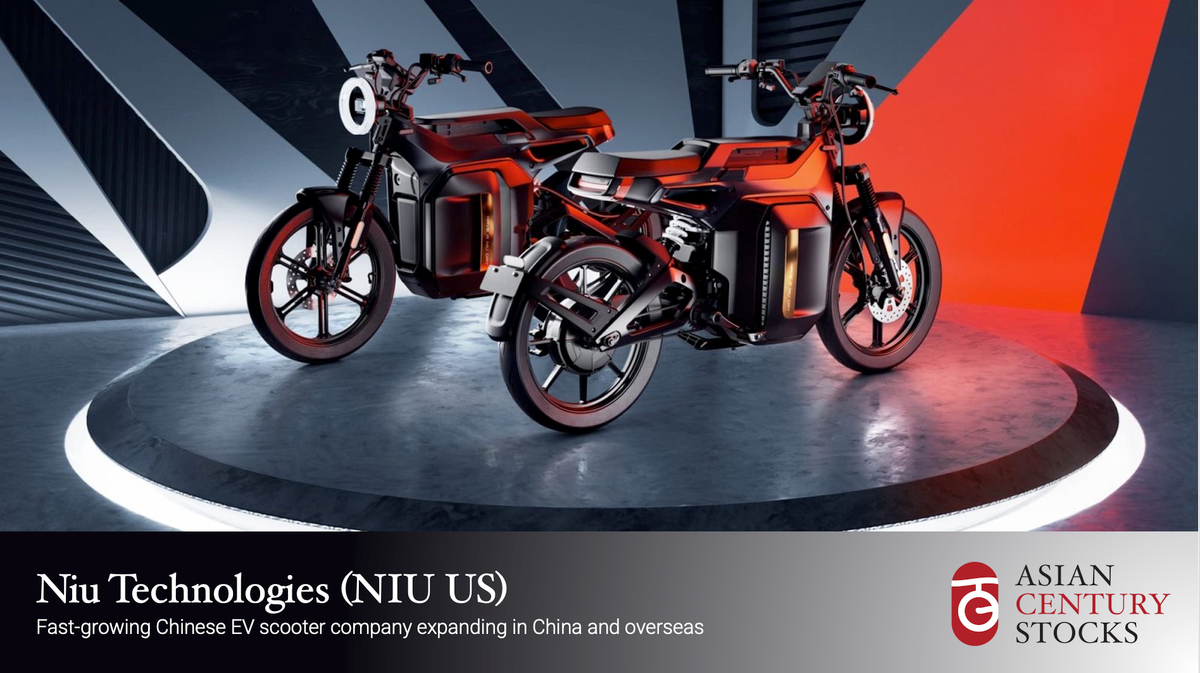
Niu Technologies (NIU US)
Fast-growing Chinese EV scooter company expanding in China and overseas

Disclaimer: Asian Century Stocks uses information sources believed to be reliable, but their accuracy cannot be guaranteed. The information contained in this publication is not intended to constitute individual investment advice and is not designed to meet your personal financial situation. The opinions expressed in such publications are those of the publisher and are subject to change without notice. You are advised to discuss your investment options with your financial advisers, including whether any investment is suitable for your specific needs. From time to time, I may have positions in the securities covered in the articles on this website. Full disclosure: I do not hold a position in Niu Technologies at the time of publishing this article. Note that this is disclosure and not a recommendation to buy or sell.
Niu Technologies (NIU US) is a Chinese producer of electric scooters. It was founded in 2014 and has quickly gained a following thanks to Niu’s distinctive design language and unique product features.
I’m impressed by Niu’s management team, led by CEO Li Yan and co-founder Token Hu. They seem serious about building Niu into a global powerhouse. You can find a GGV Capital interview with them here.
Niu’s scooters cost about CNY 4,000 in China but way more in Europe, where Niu is also expanding quickly. The majority of Niu’s Chinese scooters stay below the 25km/h maximum speed limit required to avoid the burden of getting a motorcycle license plate and driver’s license. That means that the scooters are mostly used for commuting.
The high torque of electric motors and the resulting fast acceleration makes them fun to drive. Customers also seem to enjoy the technology features of Niu scooters, including the app that can be used to track the vehicle’s location, seamless unlocking, checking the battery status, for insurance claims, and so on.
While relatively small in China’s ~30 million units a year electric scooter market, Niu dominates the fast-growing lithium-ion battery scooter market in top-tier markets. Thanks to regulation and declining lithium-ion battery prices, such scooters have gained market share over the past decade.
Most of China’s electric scooters are still of the lead acid battery variant, and sooner or later, these will be phased out and replaced by lithium-ion battery versions, including those produced by Niu.
Investors seem to favour passenger vehicle EVs over electric scooters. But scooters are much more suitable for electrification, given their low weight and low ticket prices. Asian cities also tend to be heavily congested, and electric scooters solve both the pollution problem and the congestion in one go.
The company has had a tough year, with the shares down 88% from the peak, despite zero debt and a solid net cash position. The primary reason is that Niu engaged in rapid store expansion, while the launch of the mass-market GOVA scooter has brought down the ASP and overall margin. It takes a few years for stores to reach maturity (40-60 scooters sold per month), and so the expansion has weighed on earnings temporarily.
And then, in 2022, Niu suffered from zero-COVID-related lockdowns, causing stores to shut down and sales to plummet below -20% YoY in China.
In addition, rising lithium prices have also forced Niu to raise its prices, leading to lead acid batteries taking back lost market share from lithium-ion battery scooters.
Up until COVID-19, the overall market for lithium-ion battery scooters in China grew at 20-30% per year. Any international expansion will further add to growth. So once China learns to “live with COVID”, it’s plausible that store sales will recover and that they will eventually become mature in terms of sales/store. Under such a scenario, it’s plausible that Niu could eventually sell 1.5 million units per year - if not more.
The run-rate EV/Sales is around 0.70x. Given that operating margins in the sector are in the mid-single digits and Niu itself enjoyed 7-9% margins between 2019 and 2021, it’s plausible that the stock will eventually reach an EV/EBIT below 10x. If the 1.5 million unit number is reached at a steady ASP, the stock will probably reach closer to 5x EV/EBIT.
There are many risks with Chinese concept stocks such as Niu. One is that the health of distributors is difficult to gauge. It’s possible that inventory has been piling up, certainly since new lockdowns were put into effect in 2022.
One of Niu Technologies founder’s “Li Yinan” quit in 2018 and started an unrelated passenger vehicle EV company called Niutron. Since he remains a shareholder of Niu Technologies, I worry that he might one day decide to merge the two companies.
The other risks are related to the VIE structure, delisting risks and the risk of future related party transactions, as mentioned above.