FANUC (6954 JP)
World leader in CNC devices and industrial robots to enjoy yet another cycle

Disclaimer: Asian Century Stocks uses information sources believed to be reliable, but their accuracy cannot be guaranteed. The information contained in this publication is not intended to constitute individual investment advice and is not designed to meet your personal financial situation. The opinions expressed in such publications are those of the publisher and are subject to change without notice. You are advised to discuss your investment options with your financial advisers, including whether any investment is suitable for your specific needs. From time to time, I may have positions in the securities covered in the articles on this website. Full disclosure: I do not hold a position in FANUC at the time of publishing this article. Note that this is disclosure and not a recommendation to buy or sell.
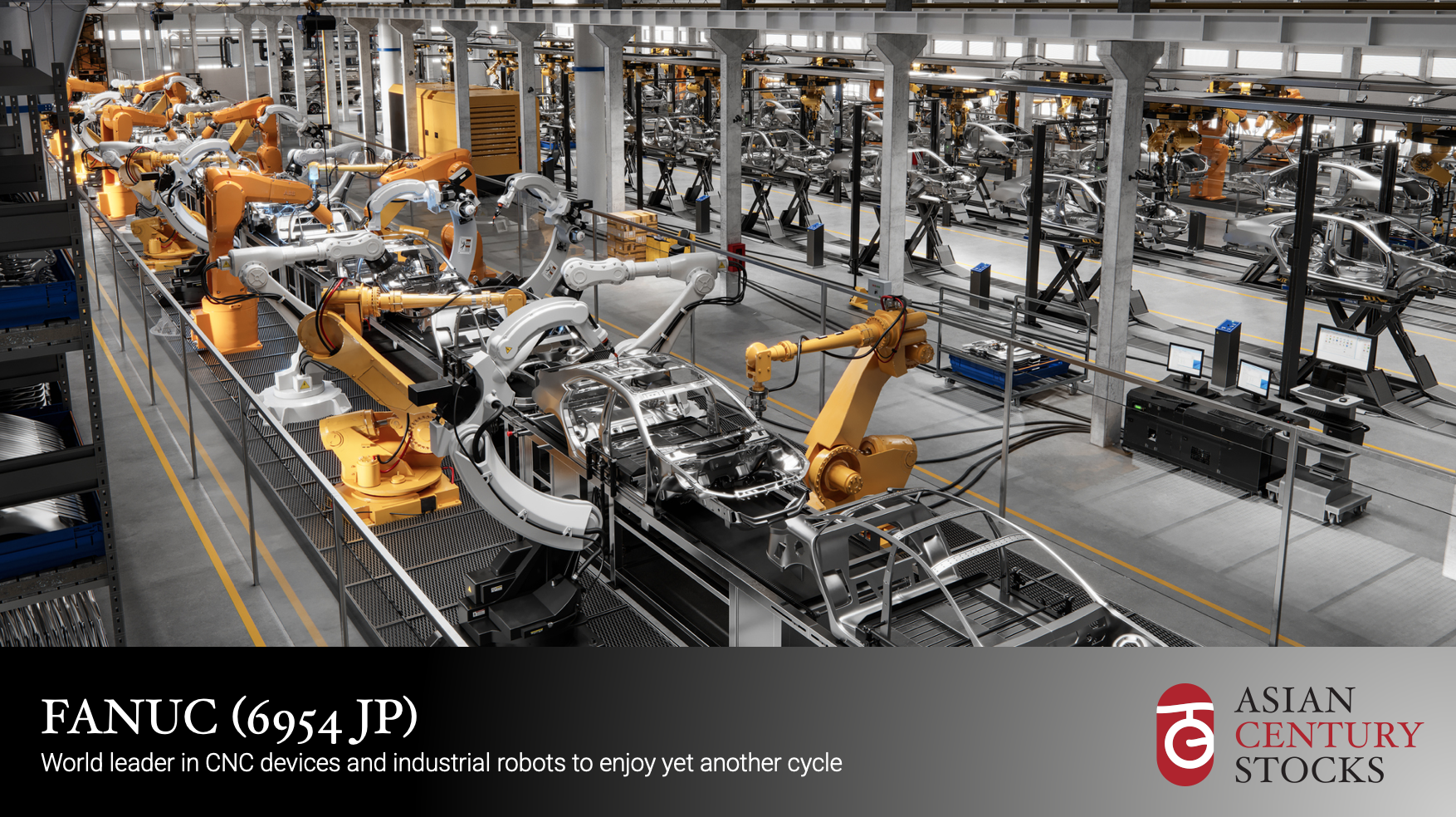
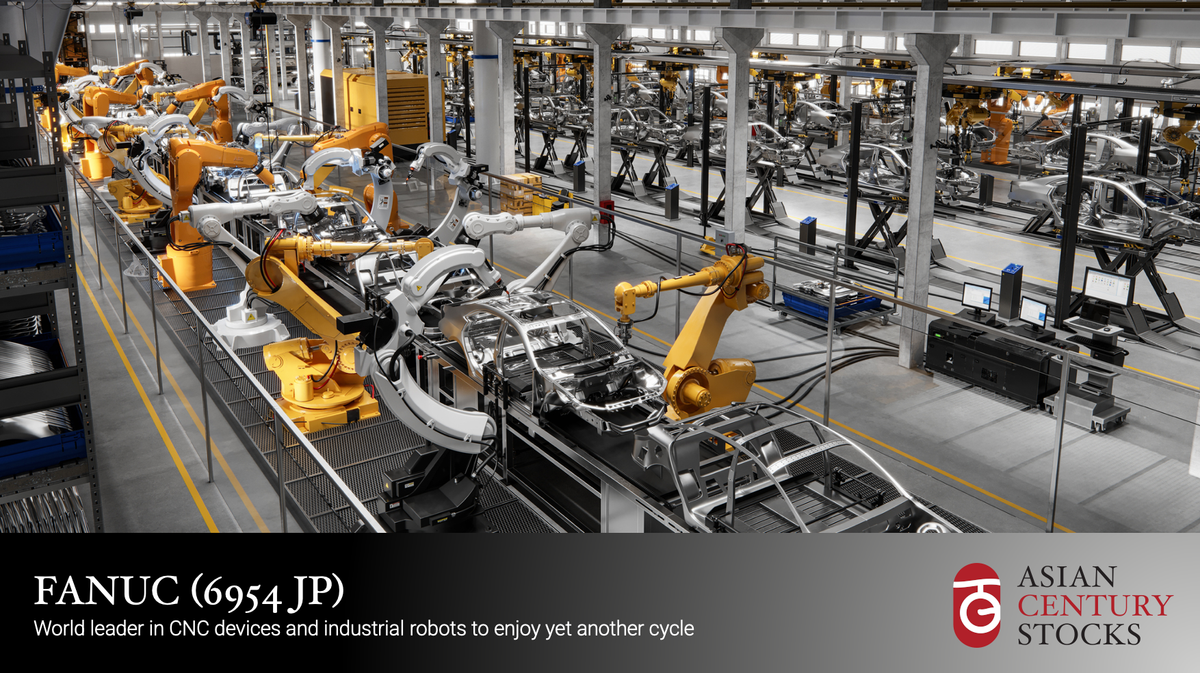
FANUC (6954 JP) is a Japanese industrial automation company. Its product portfolio includes:
- Computer numerical control (CNC) systems. CNC devices are a type of computer used to program machine tools. FANUC has a global market share of 50% in this segment.
- Industrial robots. FANUC has gained market share in the industrial robot segment and now has a 20% global market share with industry-leading margins.
With weakening demographics and rising ages in countries such as China, companies such as Volkswagen and Apple are increasingly automating their production lines to improve quality control and productivity. The economic decoupling that’s taking place between China and the Western bloc could also spark the “near-shoring” of manufacturing capacity back to Europe and the Americas. Such an economic decoupling will necessitate investments in industrial automation tools.
The company is not necessarily a first-mover when it comes to technology. Instead, you can think of FANUC as the “Toyota of the industrial automation sector”. FANUC’s products are cheaper than its competitors, yet more reliable and with better service. FANUC’s products are highly standardised, improving the company’s ability to maintain quality control while keeping costs low. For example, one customer said that “FANUC robots simply do not break.”
A 2015 article in the Financial Times described FANUC as a “cult”, not unlike other highly successful organisations such as Samsung Electronics, Lululemon and Apple. In their own words:
“The clock [running 10x faster than normal] is not the only oddity about FANUC, a ruthlessly focused Japanese organisation that is run more like a cult than a normal company. Staff wear yellow, the favourite colour of FANUC's 89-year old founder Seieumon Inaba. The buildings are yellow and the on-site buses are yellow. Visitors are generally not welcome.”
FANUC came into existence as a spin-off from Fujitsu in 1972 and is an acronym for “Fuji Automatic NUmerical Control”. Engineer Seiuemon Inaba built up the company in his image from the mid-1970s onwards. He eventually left the reins to his son in 2013. In 2014, US activist Dan Loeb’s hedge fund Third Point took a position and wrote a letter to FANUC’s management team, praising the company for its operational excellence:
“FANUC is a unique company with a long history of being the best and fastest to market in everything it does... Its relentless focus on producing only a limited number of products that are technically superior with the lowest possible cost structure... reminds us of Apple in its product approach.”
But at the same time, Loeb criticised FANUC for being secretive and pushed it to improve capital allocation. Loeb suggested to FANUC that it buy back shares, increase the dividend payout ratio and improve investor disclosures. Since then, the company’s capital allocation has improved significantly, with a 60% dividend payout ratio and recurring share buybacks.
FANUC has always traded at high multiples, and today is no exception. But what’s different about this time is that from 2016 to 2021, FANUC spent heavily on a new factory automation software system called “FIELD”. It violated the “matching principle” of accounting by expensing the entire development cost, causing the R&D/sales ratio to rise over four percentage points, with no corresponding revenue rise. That caused margins to plummet. It also built a new, highly automated factory in Mibu and a second production line in Tsubuka, which remain largely unused. FANUC investment period is now over, with FIELD system revenue increasing slowly but steadily. Factory utilisation rates are also rising with significant operating leverage.
The machine tool industry is cyclical. I’ve discovered that FANUC’s stock price is most correlated with orders received in yen terms and the company’s YoY revenue growth. For month-on-month tracking, Japan machine tool orders (JNMTOT Index) can also be used as a coincident indicator.
FANUC’s EPS growth is likely to accelerate. The reason is that FANUC’s production output has been constrained by component shortages, especially in terms of semiconductor chips. The company is also a beneficiary of the weak yen since it produces 100% of its products domestically in Japan and gets 85% of its revenues from overseas.
On the other hand, I fear that orders will slump in 2Q and 3Q as China’s zero-COVID policy causes factories to tighten their belts. So the coast will not be clear until the Chinese government decides to live with endemic COVID. I don’t expect that to happen until after the Communist Party’s National Congress in October 2022.
The truth is that despite FANUC’s dominance in CNC devices and industrial robots, it is not a fast-growing company. Many investors will therefore choose to play the cycle when it comes to the stock. On that note, FANUC currently trades at the bottom of its historical P/B range of 2.5-3.8x.
Assuming a four percentage point drop in SG&A as FIELD system development costs are phased out, as well as a rise to 44% gross profit margin as service sector revenue improves and FANUC’s utilisation rates improve, you would end up with an EPS of JPY 1,274 by 2027 - equivalent to P/E 16.0x and EV/EBIT 11.5x.
One risk is that management continues to spend heavily on R&D without much to show for it. Some sell-side analysts worry about that possibility. Another risk is that China’s zero-COVID policy and semiconductor component shortages last longer than expected.
Click the “Read now” button below to access the full PowerPoint presentation: