Hi! Welcome to a subscriber-only edition of Asian Century Stocks – a newsletter about Asian value stocks. For a complete list of all previous posts, check out the Table of Contents.
Disclaimer: Asian Century Stocks uses information sources believed to be reliable, but their accuracy cannot be guaranteed. The information contained in this publication is not intended to constitute individual investment advice and is not designed to meet your personal financial situation. The opinions expressed in such publications are those of the publisher and are subject to change without notice. You are advised to discuss your investment options with your financial advisers, including whether any investment suits your specific needs. From time to time, I may have positions in the securities covered in the articles on this website. Full disclosure: I do not hold a position in Casio Computer at the time of publishing this article. To reiterate, this post and the presentation below are for informational and educational purposes only — not a recommendation to buy or sell shares.

Summary
- Casio is one of the world's largest producers of wristwatches, mostly under the iconic Casio and G-Shock brand names. It sells 17 million watches annually. These watches have the unique selling point that they're cheap, low-maintenance, and ultra-durable.
- The company's financial performance has been weak for many years, with Casio lagging behind Apple's and Garmin's latest watches. However, the appointment of Shin Takano in mid-2025 may have been a turning point. Around that time, Casio transitioned to a decentralized organizational structure. New department heads, such as Oh Takahashi in the timepiece division, has been given free rein to develop new products and market them.
- We've already seen significant progress since that time. In the latest quarter, Casio reported a +34.5% year-on-year growth in the timepiece division. Iconic models such as the "Casioak" line are selling particularly well. They've taken bold steps to update the original G-Shock Square line to Memory-In-Pixel (MIP) displays. And Casio has appointed regional brand ambassadors to better reach consumers.
- After the recent run-up, the stock now trades at 1.0x EV/Sales. With the latest quarter's operating margin already at 11.5%, it's plausible the stock will eventually trade below 10x EV/EBIT. That's remarkable for a company run by a seasoned finance professional.
- The main risk is that fashion is cyclical. Retro designs are popular today, but may fall out of favor tomorrow. I also think that Apple and Garmin are formidable competitors, and it's not clear whether Casio can ever catch up technologically.
A quick background
Casio Computer (6952 JP — US$2.4 billion) is a Japanese company that produces wristwatches and other consumer electronics.
It's most famous for its "Casio" and "G-Shock" brand names, selling 17 million watches annually.
I published my original deep dive on Casio back in 2022. At that time, I pictured that it would benefit from a weaker Japanese Yen, on top of a nascent trend where consumers would get into the collecting of watches:

It's an old company. And it's had to reinvent itself many times over. It was initially formed as a partnership between the four brothers of the "Kashio" family in 1957.
The father initially served as Chairman, but the business was really run by the four brothers, each taking on different roles within the company.

Their first product was the A-14 electric calculator - a product that was novel at the time and cost more than US$1,000 in today's dollars.
Over time, the company broadened its product portfolio to include other consumer electronic items, such as cash registers, digital cameras, and, finally, in 1973, Casio-branded wristwatches.
At the time, Swiss mechanical watches dominated the industry. But cheaper electronic so-called "quartz" watches undercut them on price, leading to an upheaval in the industry. Many of the Swiss watch companies had to cut their staff and reorganize in what's now become known as the quartz crisis.
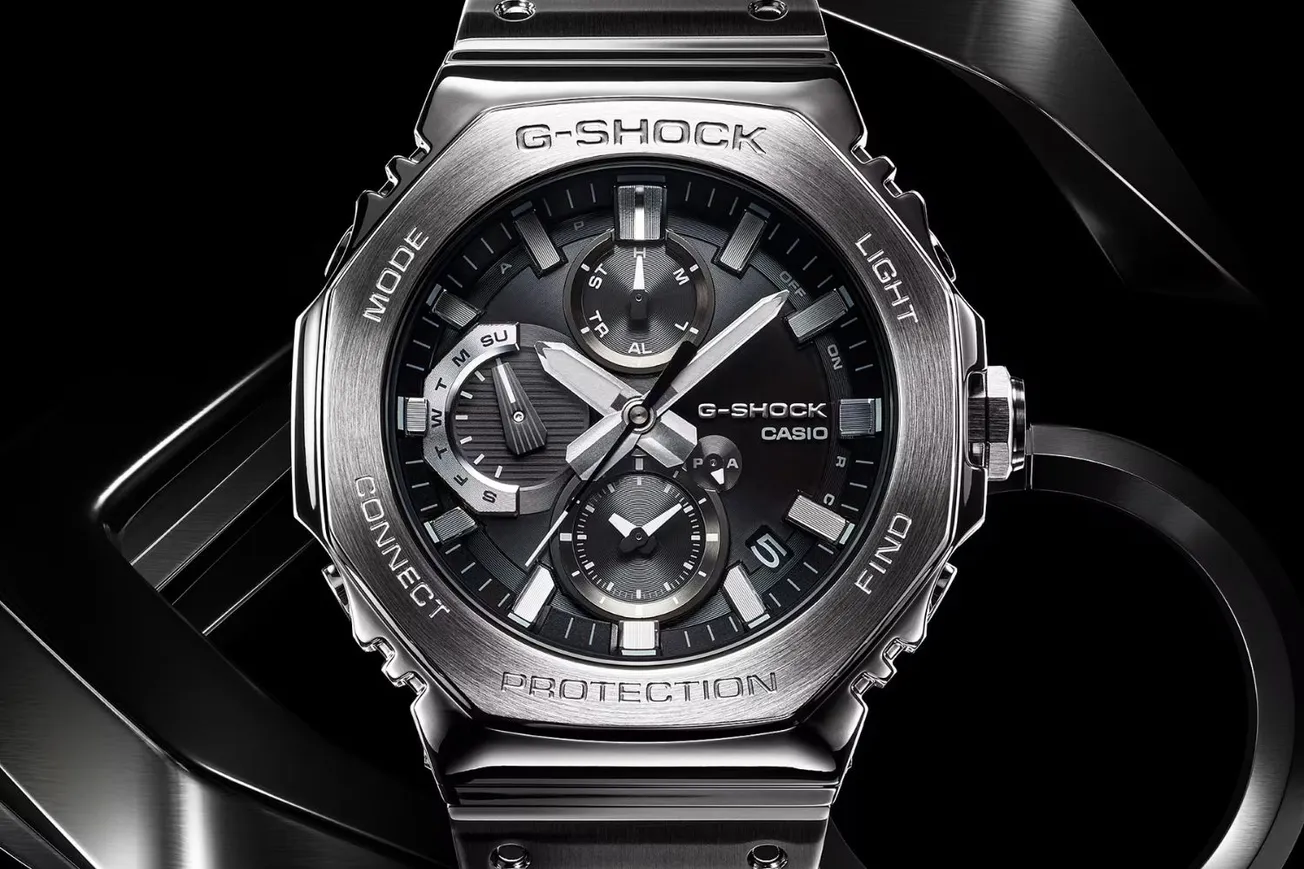
Soon thereafter, Casio released its now-famous "G-Shock" line of watches. These are shock-resistant, ultra-durable watches that can be thrown off a mountain and land on the ground, still intact.
The G-Shock franchise began when Casio engineer Kikuo Ibe accidentally dropped his father's pocket, breaking it into a thousand pieces.

He went into his lab to find a solution. After 200 prototypes, he finally came up with the original "G-Shock" design, which had ten layers of protection and a floating quartz timekeeping module in the center. The watch was virtually indestructible, attracting millions of fans worldwide.
In 1995, Casio entered the digital camera market, competing head-on with Nikon and Canon with great success. But it missed the shift to DSLRs and was eventually outcompeted by ever-improving smartphone cameras.
Around the same time, it also got into the mobile phone business. But again, after merging with Hitachi's phone operations in 2004, and then with NEC in 2010, the business ultimately failed. Yet again, Casio had been unable to keep up with the times.
A look at Casio's leadership transitions explains some of the issues it's faced throughout the years:
- From 1960 to 1988, the oldest brother, Tadao Kashio, led the company. Tadao was an inventor who personally developed Casio's first electric calculator and then its digital watches.
- But in 1988, his brother and master salesman, Kazuo Kashio, took over. He managed to popularize the G-Shock brand, making it into a collector's item. However, during their period, Casio also fell behind technologically.
- In 2015, Kazuo's son Kazuhiro Kashio took over. His reign has been marked by evolutionary, rather than revolutionary shifts. Facing competition from the Apple Watch, he's tried to modernize the timepiece business, including by moving to new premium materials, slimmer models and with smartwatch functionality:

At the time of my deep dive, Casio generated 61% of its revenue from its key "timepieces" segment, selling "Casio" and "G-Shock" branded watches. Another 32% came from its consumer business, which included educational tools such as electronic dictionaries, scientific calculators, and electronic musical instruments. Finally, you had the system equipment business, selling hand-held terminals and electronic cash registers.

But the jewel was clearly the timepieces. Margins in this segment have always been high, and they clearly hold a niche within the global watch industry. G-Shocks are famously indestructible. While the features are basic, they're low-maintenance watches you don't have to worry about. And their battery lives last for years, so you don't have to remember to charge them.

Casio's timepieces segment included the following sub-brands:
- Casio, with retro-looking 1980s-style simple watches that typically use digital quartz timekeeping modules
- G-Shock, selling indestructible watches that are typically bulky but reliable. These include Master of G military-style analogue watches with advanced features that run on solar power. As well as G-Steel analog watches with similar timekeeping modules, including the "Master of G" watches. Casio had also released G-Shock smartwatches, typically running on MIP displays but still trailing Garmin in their feature sets.
- Baby-G, a version of G-Shock for smaller wrists sold to women and children
- Edifice, sporty metal chronographs inspired by motorsports
- Oceanus, a luxury-oriented brand of dress watches, mostly analog
- Protrek, a slimmer variant of G-Shock, focusing primarily on outdoor types that don't require shock-proof watches
Here are some representative watches from each of these brands:

Consumers love their G-Shocks, that's for sure. A random sample of popular G-Shock watches on Amazon had review scores of 4.5 to 4.8, with commentary like this:
“What can you say - it's a G-shock and does what it's suppose to do. Accurate and water proof to 200 meters. It's comfortable to wear, light weight and looks really nice. Good backlight.”
“Literally the best watch I’ve ever owned. Surprisingly comfortable for a $40 watch. Reliable and tough. 10 year battery life and 20 bar water resist?? Can't beat that. Aesthetics wise, in my opinion, is beautifully retro.”
“It's easy to read, the buttons are big and it's nice to press them and the watch is solar-powered. I bought that watches for serving in the army and, as I think it is perfect for that.”
“Really an amazing watch. First, let me talk about the aesthetics. It is a very handsome watch and obviously well made. It is a considerable step up in quality.”
“I got this watch for my husband as an anniversary gift and HE LOVES IT. It looks really good on him.🥰”
“I like it. I had no idea that it was so beautiful, comfortable and expensive in appearance. I recommend”
At the time of my write-up, I pictured Apple Watch and Garmin potentially co-existing with Casio and G-Shock. I was particularly encouraged to see that G-Shock sales volumes continued to rise, even after the release of the Apple Watch in 2015:

The other parts of the business were unexciting. The calculator business had been surprisingly stable, but clearly outdated in the age of iPads and smartphones. The cash register business seemed outdated as well, now that we all use mobile phones to pay. Finally, while the electronic music instrument business might be stable, there's tough competition from the much larger Japanese competitor, Yamaha.
Casio's challenges were obvious from the multi-year decline in its revenues:

After Kazuhiro Kashio took over in 2018, he introduced an early retirement program for senior Casio executives. He also replaced some of them with younger faces. And he changed the organizational structure so that the planning & development personnel would work together with the marketing personnel to better understand customer needs. I pictured that this could help Casio innovate faster.
In 2020, we saw an uptick in Google search queries for "G-Shock", most likely thanks to their new "Casioak" line of analog watches:

So perhaps the restructuring was working. I also pictured that weakness in the Japanese Yen might improve Casio's competitiveness and boost its margins. 75% of Casio's revenues came from overseas, and some of its watches were made at its Higashine plant in Japan. The translation effect alone should have increased sales by +17%.
But it was contingent on a recovery in revenues after the COVID-19 chip shortage and the shutdown of manufacturing capacity. And in the long term, whether Casio could effectively compete with the Apple Watch and newer watches from Garmin and others.