JD.com (JD US)
Trusted online retailer trading at a 9x P/E with a coming margin inflection

Disclaimer: Asian Century Stocks uses information sources believed to be reliable, but their accuracy cannot be guaranteed. The information contained in this publication is not intended to constitute individual investment advice and is not designed to meet your personal financial situation. The opinions expressed in such publications are those of the publisher and are subject to change without notice. You are advised to discuss your investment options with your financial advisers, including whether any investment suits your specific needs. From time to time, I may have positions in the securities covered in the articles on this website. Full disclosure: I do not hold a position in JD.com at the time of publishing this article. To reiterate, this post and the below presentation are for informational and educational purposes only - not a recommendation to buy or sell shares.
China-focused Twitter user “pandawatch” posted a tweet comparing the total shareholder return of Chinese tech companies.
At the top of the list was online retailer JD.com (JD US — US$57 billion) with a total dividend yield and buyback yield of 10% — even after deducting share-based compensation. That’s impressively high.
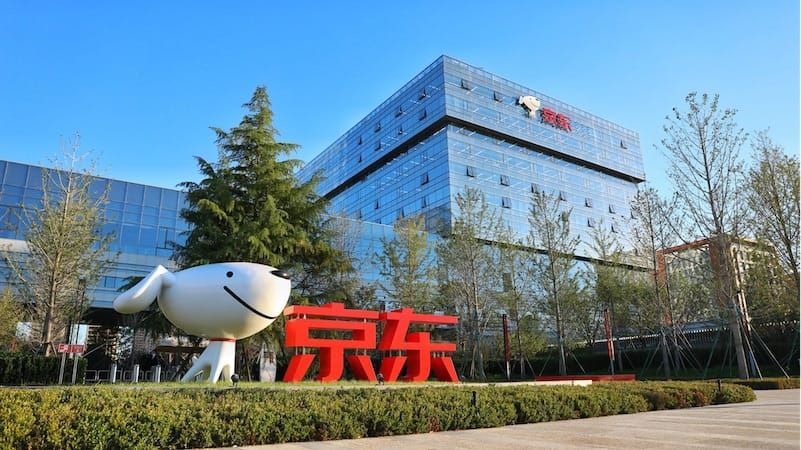
JD is one of China’s largest e-commerce companies. It dominates the niche of selling authentic, branded goods online with fast and reliable delivery. Unlike Alibaba, JD focuses on selling authentic products directly to consumers, taking on inventory risk and delivering packages straight to customers’ doors.
The company was founded by Richard Liu, the son of a peasant farmer in China’s Jiangsu province. He managed to get into the top Renmin University in Beijing and then ventured on a path of entrepreneurship.
Richard’s first business was a restaurant, which failed within months due to employee embezzlement. He then found gainful employment, saved money along the way and used that money to start an electronics shop in Beijing.
Within five years, his business had grown to a network of 12 shops with CNY 10 million in total turnover. But then came the SARS epidemic of 2003, causing foot traffic to grind to a halt. Richard then decided to close all stores and shift to an online model. That online business later became JD.com and became a smashing success.
Up until 2007, JD.com had a relatively small footprint. Yet somehow, he managed to raise US$1.0 billion to build out proprietary logistics infrastructure. It’s unclear where the money came from, but he must have had powerful backers.
Today, JD has built logistics infrastructure across most of China’s larger cities with 1,500 warehouses, seven fulfilment centers and 6,700 delivery stations. And the numbers speak for themselves: 93% of packages are delivered within the next day. In contrast, products from Alibaba’s marketplaces can take three or more days until delivery.
China’s e-commerce market grew nicely during COVID-19. However, after the zero-COVID policy was lifted in 2022, growth decelerated to around 10% yearly. Investors were not impressed, and valuation multiples contracted accordingly.
Another issue has been the government’s crackdown on tech companies. In 2021, both Tencent and Alibaba were forced to pay CNY 50 billion each in “common prosperity” donations. Fines were imposed for companies engaging in monopolistic behaviors. The Chinese state received “golden shares” in several companies. CEOs across the industry resigned — perhaps even pushed out — from the organizations they had built.
Finally, the industry has seen new challengers like Pinduoduo and short video platforms like Douyin. Fellow e-commerce platform Pinduoduo sells white-label products directly from factories at cutthroat prices. Meanwhile, Douyin has enabled influencers to sell products through short videos, much like QVC did during the TV era.
I don’t want to minimize these challenges, as they are real. However, JD was relatively unaffected by these challenges. In fact, it’s even benefitting from the end of monopolistic supplier exclusivity agreements at Alibaba. And it’s not directly competing with the short video platforms. JD occupies its niche of fast and reliable delivery of branded goods, which continues to be the case.
I believe JD will grow its gross merchandise volumes in the high-single-digit range for the foreseeable future. Meanwhile, with new CEO Sandy Ran Xu being laser-focused on margins, I believe she will achieve the medium-term operating margin target of 5-6%. With these assumptions, I get to 2027e earnings per share of CNY 29, implying a P/E ratio of 9x with a cash-rich balance sheet.
These valuation multiples are low in a regional perspective. For example, the Korean e-commerce platform Coupang trades at 1.1x EV/Sales and 58x P/E. Taiwan’s Momo.com trades at 0.7x EV/Sales and 25x P/E.
I agree with Scott Bessent when he says that there might be a 5-10-20% risk of a total wipeout in overseas-listed Chinese equities if, one day, the government decides that VIE structures are illegal or blocks dividend distributions to overseas entities.
JD and other overseas-listed Chinese tech companies employ complex corporate structures in which minority shareholders don’t own physical assets. Instead, they own profit-sharing agreements with Mainland Chinese entities. Why? Because according to Chinese law, foreigners are not allowed to own companies within the software industry.
The complexity of the VIE structure has made me skeptical of these companies, thinking they’re just trading sardines. However, seeing JD and Alibaba buy back shares is encouraging. JD just completed a US$3.0 billion share buyback, and another US$5.0 billion is underway. These are big numbers.
In my view, there’s only one reason management teams buy back shares: they think the shares are worth something. Otherwise, they’d be throwing money into the sea. And at 9x forward P/E, I can see why JD’s management team thinks the shares are undervalued.
Click the “Download” button to access the full PowerPoint presentation: