Table of Contents
Disclaimer: This article constitutes the author’s personal views and is for entertainment and educational purposes only. It is not to be construed as financial advice in any shape or form. Please do your own research and seek your own advice from a qualified financial advisor. From time to time, the author might hold positions in the below-mentioned stocks consistent with the views and opinions expressed in this article. This is a disclosure, not a recommendation to buy or sell stocks.
The Japanese government is about to introduce additional subsidies for private high school students.
35% of Japan's high school students are in private schools, so we're talking about approximately 1 million students. In the past, only families with a household income below JPY 9.1 million (US$58,000) received any subsidies. The households with an income above JPY 9.1 million did not receive any subsidies at all.
From 1 April 2026, this JPY 9.1 million income cap will be removed, meaning that everyone will receive the full, new subsidy amount of JPY 457,000 (US$2,900) per year. This will be a significant improvement from before.
I suspect that at least part of the savings will be redeployed into tuition services run by Japan's infamous cram schools ("juku"). Every parent wants their child to gain an advantage in Japan's fiercely competitive university entrance exams. And that's why nearly 40% of private high school students in Japan attend cram schools today.
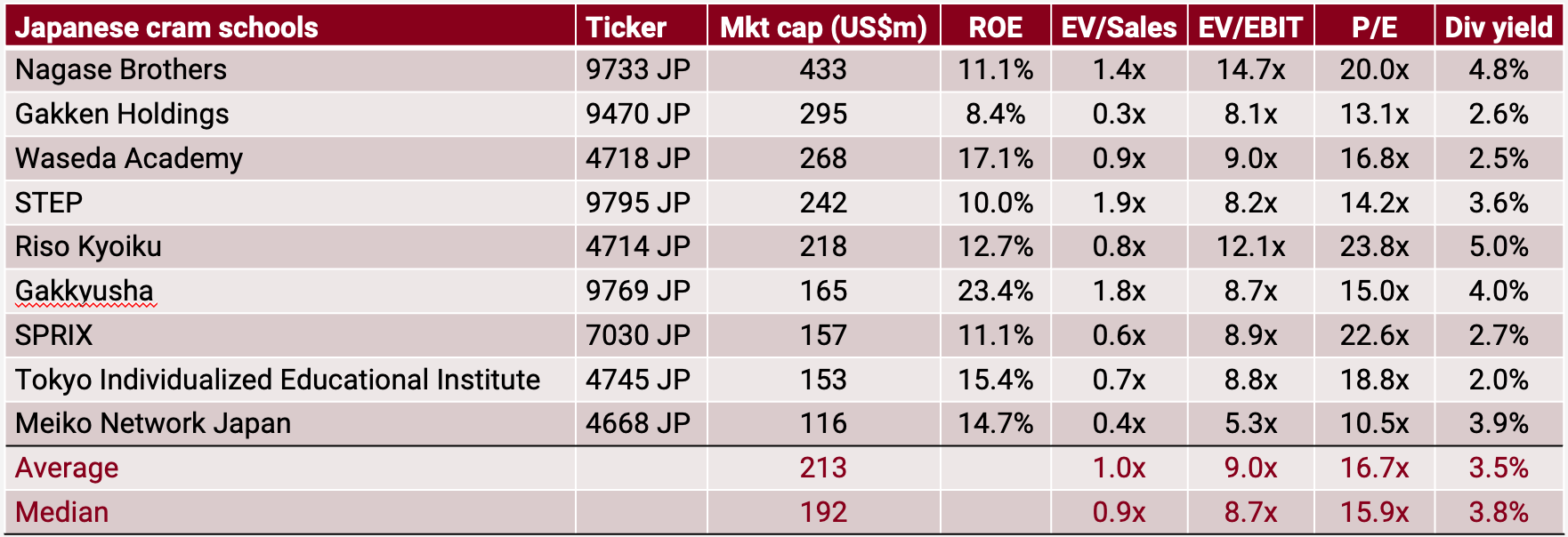
Here is what the investable universe of publicly listed cram schools looks like in Japan:
There are two types of cram schools:
- Traditional classroom teaching, where star teachers attract groups of 20-30 students
- Individualized teaching, where shy students in classes of just 1-3 get help from teachers, often working part-time
Individualized teaching is gaining market share, but tends to carry lower margins.
Nagase Brothers and Waseda Academy are the go-to cram schools for students seeking entry into top universities in Tokyo and beyond. Gakken Holdings is a conglomerate where cram schools are just a small part of the total business. STEP is a local cram school in Kanagawa that provides traditional classroom instruction, focusing primarily on high school entrance exams. Riso Kyoiku provides individualized education through 1:1 instruction to help high school students gain admission to top universities. Gakkyusha helps middle school students gain admission to public high schools through traditional classroom settings. SPRIX owns a famous textbook series, and its schools help students who are lagging behind. TIEI and Meiko Network both provide individualized education; the latter does so under a franchise model.
The industry is not growing much. Japan's fertility rate is only 1.2, and the number of new births is now shrinking. There's also a question of whether generative AI tools could replicate some of what cram schools offer today.
That said, if you check out the earnings per share of, say, Gakkyusha or STEP, you'll find that these businesses have all the characteristics of long-term compounders.
And as mentioned above, I think it's likely that greater subsidies for high school tuition could benefit pure-play university entrance exam specialists such as Nagase Brothers, Waseda Academy, and Riso Kyoiku. And indirectly, the Japanese cram school-SaaS company Poper, which I've discussed previously.
 Michael Fritzell