Table of Contents
Disclaimer: This article constitutes the author’s personal views and is for entertainment and educational purposes only. It is not to be construed as financial advice in any shape or form. Please do your own research and seek your own advice from a qualified financial advisor. From time to time, the author might hold positions in the stocks mentioned below consistent with the views and opinions expressed in this article. This is a disclosure, not a recommendation to buy or sell stocks.
Let's talk about Korean products.
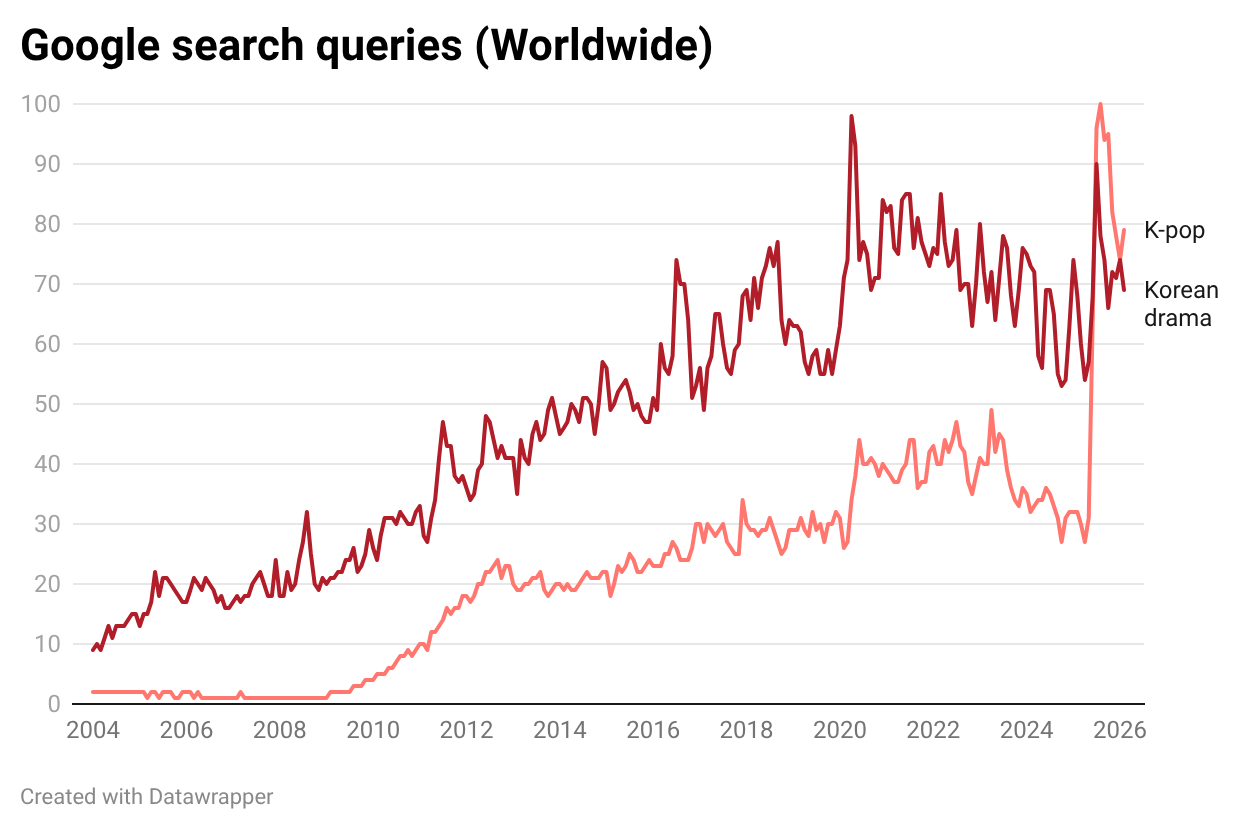
We've had a multi-decade boom in the popularity of Korean products. People refer to this trend as the Korean Wave, or simply Hallyu.
It's been a slow buildup. In the late 1990s, the Korean drama What is Love became a major success in Mainland China. And a few years later, the K-drama Winter Sonata became a sensation in Japan.
When I moved to Asia in the late 2000s, Korean pop bands like H.O.T., BoA and Girls Generation were everywhere. But in the rest of the world, the big breakthrough moment came when Korean artist Psy released his hit song Gangnam Style on YouTube. Thanks to the mass distribution of content online, Korean artists could finally reach global consumers with minimal friction.
Another milestone was when Korean director Bong Joon Ho's Parasite won the Academy Award for Best Picture in 2019. During the COVID-19 pandemic, many of us watched the thriller Squid Game, which at the time became Netflix's most-watched series ever. And just last year, the kids' movie K-pop Demon Hunters became Netflix's most-watched movie ever.
These successes are having a major impact on consumer patterns. When K-pop stars like BTS or Blackpink wear a particular piece of handbag or use a particular type of cosmetics, fans pay attention. For example, one catalyst for Labubu dolls' popularity was when Blackpink member Lisa attached a Labubu doll to her Louis Vuitton bag in 2024.

When it comes to cosmetics, K-pop stars popularized the glass skin look, and more recently, glass hair and regenerative skin care.
I think there's a whole host of Korean companies that will benefit from these successes. For example, in late 2024, I wrote about Samyang Foods, and how the "Buldak ramen" challenge had gone viral on social media:
 Michael Fritzell
More recently, Korean noodles maker Nongshim released a K-Pop Demon Hunters special edition of its instant noodles product. Another company doing well is chocolate maker Orion, whose Choco Pies are selling well in overseas markets like Vietnam, Russia and China.

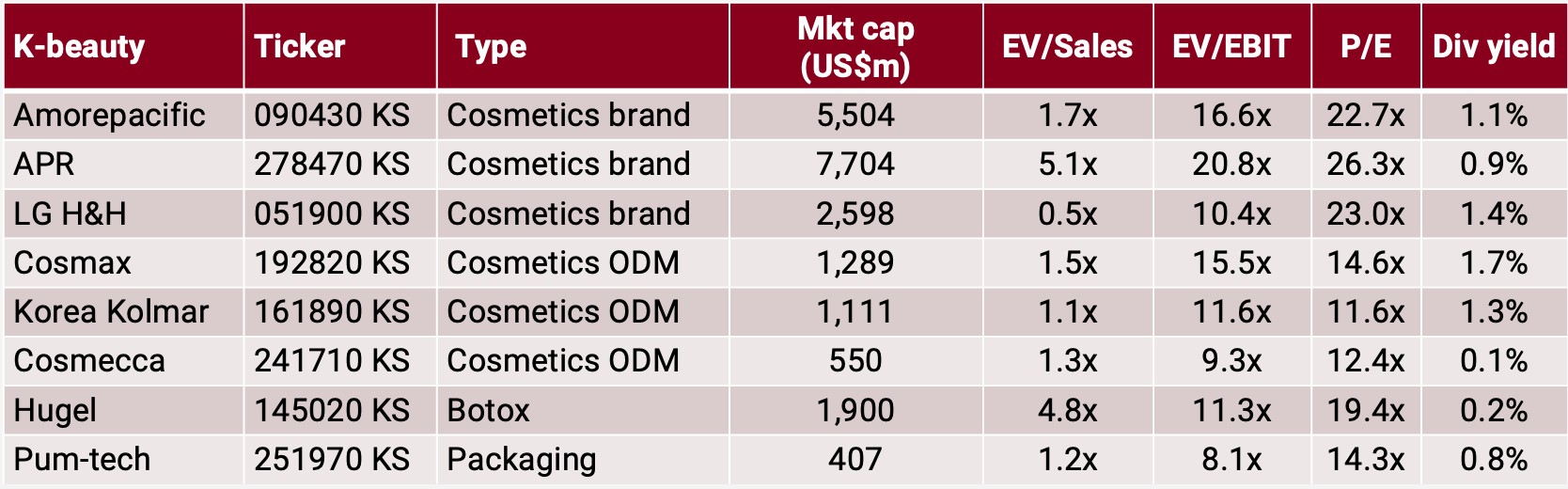
Cosmetics brands are also benefiting. Sulwhasoo and Laneige, owned by Amorepacific, lost favor among Chinese consumers after the THAAD crisis in 2017. But several of its brands are now best-sellers at the US cosmetics retailer Sephora. Another cosmetics stock, APR, was one of the best-performing in Korea in 2025 thanks to its Medicube-branded cosmetics and beauty medical devices. Botox makers like Hugel should benefit from the influx of tourists to South Korea for plastic surgery. Then we have Korean cosmetics ODMs like Cosmax, Korea Kolmar and Cosmecca, which enable Korean indie brands to scale up fast.
While K-pop and K-dramas have enjoyed immense success, the entertainment industry is hit-driven. So even though CJ ENM manages K-pop groups and funds film production, it's not particularly profitable. Korean k-drama producer Studio Dragon has had many recent hits, including Queen of Tears and Marry My Husband. Another category of products is webtoons, essentially Korean manga – better known as manhwa — readable on smartphone devices. IT giants Naver and Kakao Entertainment own two of the most popular webtoon platforms.

Finally, let's talk about tourism. A recent survey showed that 32% of young visitors to Korea cited Hallyu content as their primary reason for visiting. Tour agents such as Hanatour and Modetour should benefit, though I will admit that the younger generation tends to be less interested in group travel. Korean casino operator Paradise could benefit from greater inbound tourism, as could Korean duty-free operator Hotel Shilla. And I think Korea will likely benefit from the ongoing shift in Chinese tourism away from Japan to other countries.

The Korean Wave will continue. Over the five years to 2022, Netflix spent only US$180 million annually on Korean content. Today, it spends closer to US$625 million. And social media has levelled the playing field for Korean content to go overseas. So there are plenty of reasons to be bullish.
Exactly who will benefit is a tougher question. I think the outlook for Korean inbound tourism is excellent, even if jet fuel prices stay at these elevated levels. I've noticed insider buying in Nong Shim, suggesting optimism about the sales of instant noodles in overseas markets. I also think that a cosmetics packaging company like Pum-Tech can do well, regardless of which cosmetics brand eventually wins the hearts of global consumers.