
Table of Contents
Disclaimer: Asian Century Stocks uses information sources believed to be reliable, but their accuracy cannot be guaranteed. The information contained in this publication is not intended to constitute individual investment advice and is not designed to meet your personal financial situation. The opinions expressed in such publications are those of the publisher and are subject to change without notice. You are advised to discuss your investment options with your financial advisers, including whether any investment suits your specific needs. From time to time, I may have positions in the securities covered in the articles on this website. Full disclosure: I do not hold a position in Tai Cheung at the time of publishing this article. To reiterate, this post and the below presentation are for informational and educational purposes only - not a recommendation to buy or sell shares.
Tai Cheung (88 HK - US$261 million) is a small Hong Kong property developer. It owns 35% of the Sheraton Hotel and several higher-end residential developments on Hong Kong Island.
The stock was recently mentioned by the French Substack Patrimoine en Actions, and it’s also a long-term holding of Spain’s Horos Asset Management. I met with Tai Cheung several times in a previous job and have a decent impression of the company and its management team.
Tai Cheung has a storied history. It was founded in 1952 by a certain Edward TT Chan, who fled Guangzhou during the Second World War and ended up in Hong Kong. He was initially involved in the construction business and became a trusted partner to several Hong Kong tycoons needing his expertise. But by the 1970s, Tai Cheung had transformed into one of the top 5 Chinese-owned property developers in Hong Kong.
When Edward passed away in 1981, his son David Pun Chan took over the business. Since then, Tai Cheung has become more sleepy but still well-managed and generous with dividends. It stands out among its Hong Kong property developer peers as having decent corporate governance.
The last few years have been tough, though. The troubles began with the anti-government protests in 2019 and then escalated when Hong Kong’s borders were closed in response to COVID-19. After that, the Hong Kong government introduced a National Security Law that caused roughly 4% of the population to emigrate. And from 2022 onwards, interest rates have risen almost 500 basis points, causing residential property prices to drop about 20%. Due to these events, Tai Cheung’s own share price has dropped almost 70% from the peak.
Tai Cheung has an excellent portfolio of assets that are strategic in many ways:
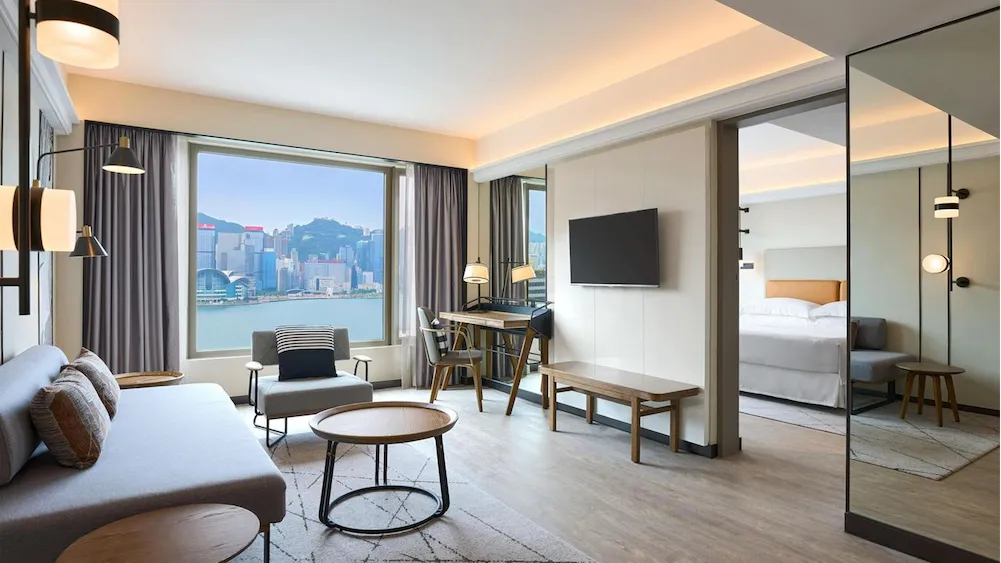
- A 35% stake in Sheraton Hotel, located right next to the Kowloon Harbourfront and overlooking the skyline on the other side of Victoria Harbour.
- A residential project on 3 Plunkett’s Road near The Peak, with amazing views and only a few minutes away by car to Central.
- Another residential project called PULSA in Repulse Bay, with eight newly built ultra-luxury villas with perfect views over the ocean.
- A construction project on Praya Road near a marina and the only luxury development on the island Ap Lei Chau.
- Strata-title properties in Metropole Square in Sha Tin and an industrial property in California.
If you add up the value of these properties, you get to a number close to HK$15/share - far higher than the current share price of HK$3.3. I calculate a discount of 79%.
Will that value ever be realized? Well, on the positive side, Tai Cheung is generous with its dividends, paying out 7.3% and potentially over 10% if the company ever reverts to its pre-COVID dividend per share of HK$0.35.
The outlook has also turned more positive. Hong Kong’s borders have opened up, and tourist arrivals are now back to 60% of their pre-2019 levels. And the halving of Hong Kong’s stamp duties for residential properties in October 2023 to just 15% has sparked a rise in the number of transactions.
While interest rates remain high, I personally believe that inflation pressures are subsiding. The market is pricing in several cuts to the US Fed Funds Rate in 2024, and HIBOR is likely to follow its downward path.
Some will argue that the 2020 National Security Law has permanently damaged Hong Kong’s ability to attract the ultra-wealthy to its shores. But I believe Hong Kong remains unique -at least in a Chinese context. There is no place like it within mainland China. And the fact that the Hong Kong Dollar is freely convertible gives the special administrative region a competitive advantage against Shanghai and Shenzhen.
In any case, Tai Cheung’s discount to NAV is now at such levels that a lot of negativity has already been priced-in. The only question is if and when investor sentiment will ever turn positive again.
Click the “Download” button below to access the full PowerPoint presentation:



)