China Overseas Land & Investment (688 HK)
State-backed COLI strikes back, now with a P/E of 5.2x

Disclaimer: Asian Century Stocks uses information sources believed to be reliable, but their accuracy cannot be guaranteed. The information contained in this publication is not intended to constitute individual investment advice and is not designed to meet your personal financial situation. The opinions expressed in such publications are those of the publisher and are subject to change without notice. You are advised to discuss your investment options with your financial advisers, including whether any investment suits your specific needs. From time to time, I may have positions in the securities covered in the articles on this website. Full disclosure: I do not hold a position in China Overseas Land & Investment at the time of publishing this article. To reiterate, this post and the below presentation are for informational and educational purposes only - not a recommendation to buy or sell shares.
China Overseas Land & Investment (688 HK - US$22 billion) - also known as “COLI” - is one of China’s largest property developers.
You might wonder why I bother spending time on the Chinese property market, now that it's in the midst of a crisis. But I want to make the case that the story is more complex than what media is portraying.
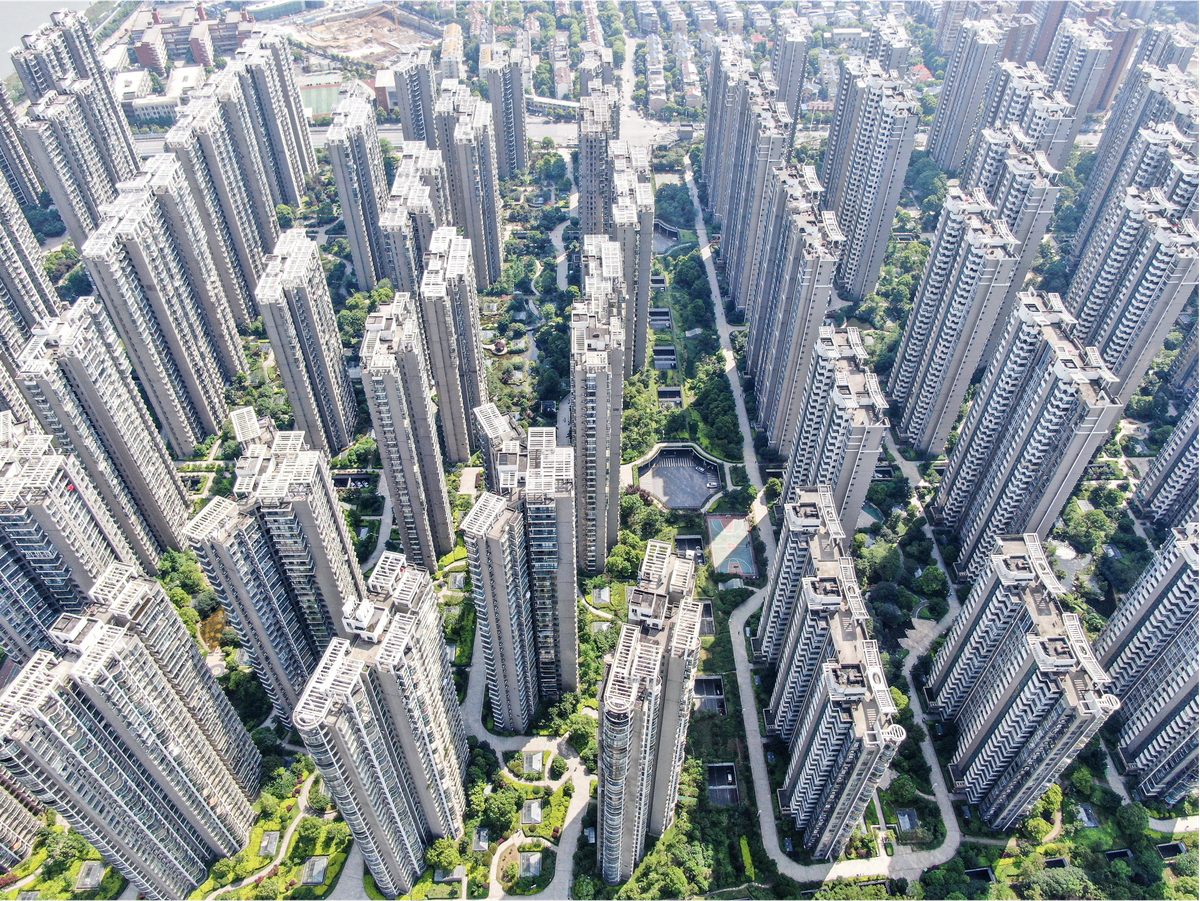
After China’s residential property market was liberalised in 1998, construction took off almost exponentially. And the floor space under construction rose 15 times in the subsequent two decades.
Eventually, construction activity became so high that the number of new starts exceeded actual sales by over 10 million apartments per year. The result was a build-up of unfinished and unsellable properties in lower-tier cities.
The solution to the over-construction problem came in August 2020. At that time, the People’s Bank of China met with 12 property developers and asked them to improve their balance sheets. The developers had to adhere to three requirements - “Three Red Lines” - including the net gearing ratio, the liability-to-asset ratio and the cash-to-short-term debt ratio.
It just so happens that almost all of China’s private property developers failed these requirements and, therefore, had to deleverage. One by one, they’ve started to default on their offshore debt and enter bankruptcy proceedings.
But despite the negative headlines, China’s state-owned enterprise (“SOE”) developers including COLI, China Resources Land and Yuexiu are doing just fine. They continue to enjoy low-cost funding from China’s state-owned banks. And buyers feel at ease buying properties from the SOE developers, knowing that they're not going to fail.
Make no mistake though: COLI has also had its fair share of challenges. Its earnings dropped in 2022, due to difficulties of completing projects during the zero-COVID policy. Ordinary citizens have also found it difficult to access the mortgage market.
So using the lens of the 2008 Great Financial Crisis to assess the Chinese property market. We're not necessarily going to see transaction volumes and home prices fall. We're just witnessing a top-down effort to deal with the overconstruction problem by cutting off the access to credit for certain developers.
In fact, I'd argue China’s state-owned developers might even benefit from the crackdown. Almost all of them have gained market share in the past two years, as buyers have shunned companies like Evergrande due to the fear of construction delays. And we’re now seeing signs of state-owned developers buying assets from their private counterparts at low valuations.
So let's talk about COLI. The company has a national footprint but a large exposure to tier 1 and 2 cities. These cities enjoy positive migration flows, tight supply and high prices. COLI has a large land bank in these cities, ensuring sellable resources for years to come. The compang also has a commercial property segment that ensures stable rental income when contract sales are weaker.
The stock now trades at a 5.2x 2024e forward P/E, a slight discount to its historical level. It trades at a discount to NAV of about 56%, which compares to roughly zero before COVID-19.
After weakness during the zero-COVID period of 2022, COLI’s contract sales is now exhibiting fast growth, with management guiding for a +20% rise in contract sales in 2023 and for rental income to recover. Given 1-2 year time lags for projects to be completed, we're almost certain to see a strong rebound in earnings in 2024.
The only question mark is the gross profit margin. It's come down quite a bit since 2019. Margins are a function of land prices and the average selling price 3-4 years later when three projects are actually sold. The higher the inflation rate, the better.
For now, China’s monetary and fiscal policy remains restrictive. But once the current crackdown is over, I would imagine that mortgage lending will finally reaccelerate. And if that happens, COLI and the other SOE developers will be some of the key beneficiaries.
Click the “Download” button below to access the full PowerPoint presentation: