
Table of Contents
Disclaimer: Asian Century Stocks uses information sources believed to be reliable, but their accuracy cannot be guaranteed. The information contained in this publication is not intended to constitute individual investment advice and is not designed to meet your personal financial situation. The opinions expressed in such publications are those of the publisher and are subject to change without notice. You are advised to discuss your investment options with your financial advisers, including whether any investment suits your specific needs. From time to time, I may have positions in the securities covered in the articles on this website. Full disclosure: I do not hold a position in IMAX China at the time of publishing this article. To reiterate, this post and the below presentation are for informational and educational purposes only - not a recommendation to buy or sell shares.
IMAX China (1970 HK - US$313 million) is the Chinese subsidiary of America’s IMAX Corporation - a leading provider of high-end cinema equipment.
The Chinese business is separately listed in Hong Kong under the ticker 1970 HK. It’s been given an exclusive license to sell IMAX theater systems to exhibitors within Greater China.
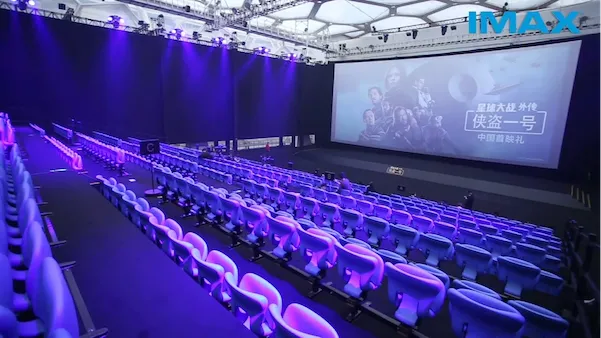
IMAX offers more immersive cinema experiences thanks to massive screens, steep seating arrangements, taller aspect ratios, better resolution and surround sound.
By selling IMAX as a better experience for the customer, it’s managed to carve out a niche for itself. And the business has become highly profitable as well, with operating margins well above 40%.
I think the explanation is that studios with blockbuster content are willing to pay IMAX for the conversion of their movies since they don’t want to miss out on revenues from IMAX’s now sizeable footprint. And customers are willing to pay extra when watching movies such as Oppenheimer or Dune since they know they’ll get the best experience.
That said, on my numbers it seems like IMAX is already charging quite a bit for their services and theaters with IMAX equipment don’t seem that profitable. I suspect that IMAX’s pricing power has pretty much been exhausted. In the future, growth will probably rely on greater scale rather than higher prices.
Since IMAX China’s IPO in 2015, the share prices has been on a long-term slide. The main reason is that installation revenue hit a peak shortly after the IPO. At that time, recurring revenue streams like maintenance and film conversion fees were small relative to the total, failing to make up for falling installations.
But today, over 70% of IMAX China’s revenues are recurring, so they are on a much better footing. And while China’s cinema industry was hit by COVID-19, it’s now in a clear recovery mode. Management guidance is positive and they expect a stronger pipeline of Hollywood blockbusters and for consumers to return to cinemas.
The stock trades at around 7.5x P/E on a forward-looking basis. But if you take into account the sizeable net cash position of 20% of market cap, you get to a lower number. For reference, IMAX China’s EV/EBIT multiple is likely to end up at around 5x. That’s undeniably a low multiple.
Some investors fear that IMAX China will be caught up in geopolitics. Hollywood content represent roughly 75-80% of IMAX box office revenues in the country. But new CEO Daniel Manwaring is ex-CAA and has strong relationships with all the Chinese studios. The transition is taking place and regardless of what content ends up on the big screen, IMAX will be there to serve customers.
Another issue is corporate governance. In 2023, parent company IMAX Corporation tried to privatize IMAX China at a bargain-basement price of just HK$10/share. But luckily minority shareholders rejected the offer.
In an earnings call with IMAX Corporation shareholders, its CEO Richard Gelfond said that dividends from IMAX China to its minorities were akin to “cash leakage”. In his own words:
“There is also cash leakage because we paid a dividend out of China and obviously close to 30% of that went outside the IMAX Corporation. So after this transaction, we'll have the ability to keep that cash as well.”
I understand his perspective but it sounds like he’s not respecting minority shareholders as equals. Parent IMAX Corporation needs the cash sitting in IMAX China. There a fear that it will play around with transfer pricing to get that cash to the parent while avoiding said “cash leakage”.
That said, the value in IMAX China is obvious to many investors. It’s a hell of a business and brand name. And IMAX China’s P/E ratio is now just 7.5x, which compares favorably to the parents’ 21.7x. We’ll see whether the gap will ever close.
Click the “Download” button below to access the full PowerPoint presentation:



)